
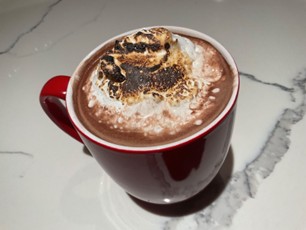
What festive drink reminds you and your family of the pure warmth and joy that the winter season brings? No matter the age, everyone has once experienced the comfort of a hot mug filled with

(Alex merkle ’28)
burning, chocolatey delight and topped with marshmallows after a day spent frolicking in the blustery, frigid snow. Whether the experience holds snowmen, snow angels, or sledding in the snow, a cup or two of hot chocolate is the perfect way to finish a day that should have been spent in school! In the United States, around 34% of people claim that hot chocolate is the superior festive beverage, and over 500 billion cups are consumed worldwide each year. The amount of money spent on hot chocolate in 2022 was $3.7 billion; by 2030, it is estimated to reach $5.7 billion. The
market’s growth rate will exceed 5% over the next five years.
Over the millennia hot chocolate has transitioned from being served cold, to now warm and from once spicy, to now sweet. The first semblance of hot chocolate was first recorded to be drunk
around 500 BC by the Mayans who drank a mixture of ground cocoa seeds with chili peppers, cornmeal, and water. The mixture was tossed between a cup and a pot until the ingredients were fully combined and a special dense foam formed. Typically, members of the aristocracy would indulge in the cold beverage through spouts attached to immense vessels that they were later buried with. In the 1500s, Hernán Cortés, an acclaimed Spanish explorer, transported cocoa beans and other necessary tools to create the cold and bitter beverage to Europe. Upon reaching the Spanish aristocracy, the beverage was no longer consumed cold or made with chile peppers, instead it was served hot and became sweeter. Just over a century later in London, Hans Sloane popularized the addition of milk to Hot Chocolate, making it a staple of English dessert. Additionally, cocoa powder was first invented in Holland towards the middle of the eighteenth century and chocolate candy became popular in Switzerland during 1876.
In the United States, until the nineteenth century, hot chocolate was used as a treatment for stomach and liver diseases. Today, store bought hot chocolate in the U.S. has a thinner consistency, while more traditional, and fancy recipes are made at home or served in restaurants and cafes. Globally, famous examples of hot chocolate include Spain’s chocolate a la taza, Italy’s cioccolata calda, and Latin America’s widely known chocolate para mesa. Over the course of human history hot chocolate has evolved from a cold spicy drink in Latin America to a beloved, warm winter drink in Western civilization.
Sources:
https://www.datamintelligence.com/research-report/hot-chocolate-market
https://www.marketgrowthreports.com/market-reports/hot-chocolate-market-110580?
https://www.thespruceeats.com/the-history-of-hot-chocolate-764463